Follow us on :

- Our Database
- Industry
- Healthcare
- Technology
- International
- C - Level
- Professionals
- Datacards
- Resources
- About Us
- Contact Us
This rapid evolution has made retail business owners some of the most active buyers of tools, services, and data—from inventory management systems and payment solutions to marketing automation and customer experience platforms.
Reaching retail business owners at scale is one of the more frustrating challenges in B2B marketing—these decision-makers are busy, their contact information decays at roughly 2.1% per month, and generic outreach rarely breaks through.
CampaignLake’s targeted retail business owners email list solves this by giving you verified contact data for the people who actually approve purchases and sign contracts.
Verified
Opt-in Contacts
Deliverability
DataFields









You can acquire a retail business owners email list in three main ways: buying a pre-packaged database from B2B data brokers like CampaignLake using lead generation platforms like Apollo.io to build custom lists filtered by retail sector and location, or manually researching contacts through LinkedIn Sales Navigator and company websites. Purchasing a verified list is typically the fastest route, giving you segmented, ready-to-use data without hours of manual research.
A retail business owners email list is a database containing contact details for owners, executives, and decision-makers in the retail industry. Most lists include both email addresses and physical mailing addresses, along with phone numbers and company information that support outreach across multiple channels.
Businesses use this data for B2B sales, lead generation, and targeted marketing campaigns aimed at retail professionals. Whether you’re selling point-of-sale software, wholesale inventory, or merchant services, accurate contact data connects you with the decision-makers who actually sign contracts and approve purchases.

Data quality affects every metric in outbound marketing. When contact information is outdated or unverified, emails bounce, budgets get wasted, and sender reputation takes a hit—problems that compound with each campaign.
Verified emails land in inboxes instead of bouncing or getting flagged as spam. When your messages actually arrive, engagement becomes possible. Even a modest improvement in deliverability can meaningfully lift overall campaign performance.
Permission-based lists help you avoid legal penalties and maintain credibility with email providers. The CAN-SPAM Act governs commercial email in the United States, while GDPR applies to contacts in the European Union. Working with opt-in data protects both your reputation and your business from regulatory exposure.
Every email sent to an invalid address or irrelevant contact is a resource spent with no return. Accurate data means your team focuses on conversations with qualified prospects rather than chasing dead ends or cleaning up bounced campaigns.
Accurate retail owner contact data allows you to segment your audience more effectively based on factors like business size, location, product category, and buying behavior.
The value of a contact list depends largely on the depth of its data fields. More attributes mean more ways to segment, personalize, and qualify your outreach.
Contact Information
The core fields—name, email, phone, and mailing address—are what make direct outreach possible. Verified email addresses are especially valuable because they reduce bounce rates and protect your sender reputation over time.
Company and Firmographic Data
Company name, size, revenue, and website help you qualify leads before you ever reach out. You can use firmographic data to prioritize prospects that match your ideal customer profile and personalize your messaging based on their business context.
Industry and Segmentation Fields
SIC and NAICS codes let you target specific retail subsectors rather than the entire industry. When combined with geography filters, you can build highly focused lists—say, apparel retailers in the Southeast or grocery store owners in urban markets.
Retail is a broad category, and the differences between subsectors matter for campaign relevance. With over 2.8 million retail trade businesses in the U.S., a pitch that works for a boutique owner probably won’t land with a grocery chain executive.
This segment covers quick-service food retailers, convenience stores, and supermarket owners. Businesses in this space often look for inventory management tools, supplier relationships, and point-of-sale upgrades.
Clothing stores, footwear retailers, and accessories shops fall here. Fashion retailers tend to respond well to offers around e-commerce integration, seasonal financing, and visual merchandising solutions.
Department stores, large-format retailers, and regional or national chains make up this category. Decision-making often involves multiple stakeholders, so account-based approaches work better than single-touch outreach.
Independent specialty retailers, gift shops, and niche product stores represent a significant slice of the market. These small business owners are often more accessible and make purchasing decisions faster than their enterprise counterparts.
Online store owners selling through Shopify, Amazon, WooCommerce, or Magento are a fast-growing segment. Their priorities typically center on digital marketing, fulfillment logistics, and payment processing.
This segment includes businesses such as salons, spas, cosmetic stores, and wellness product retailers. These owners are highly focused on customer experience, repeat business, and brand loyalty, making them strong prospects for solutions.
Several types of businesses find value in targeted retail contact data. The common thread is a need to reach retail decision-makers efficiently and at scale.
Companies selling POS systems, inventory management software, or retail analytics use contact lists to connect with potential buyers. Retail owners are constantly evaluating technology to improve operations and margins.
Agencies running campaigns for clients in the retail space benefit from pre-built, verified lists. This lets them focus on strategy and creative work rather than data sourcing.
Wholesalers and distributors looking to expand their distribution networks rely on accurate contact data to identify stores that match their product categories. A targeted list helps surface the right buyers faster than cold prospecting.
Banks, lenders, and payment solution providers frequently target retail merchants for business loans, merchant accounts, and financial products. Retail owners represent a substantial addressable market for these offerings.
A quality list can support outreach across multiple channels. The key is matching your approach to your audience and campaign goals.

Import the list into your email platform or CRM for automated drip sequences and personalized cold emails. Segmenting by store type or geography lets you tailor messaging for different retail audiences.
Physical mailing addresses enable postcards, catalogs, or promotional mailers sent directly to business locations. Direct mail achieves a 4.4% average response rate compared to email’s 0.12%, making it particularly effective for local or regional campaigns.
Combining email, phone, social, and direct mail creates integrated account-based marketing motions. ABM—account-based marketing—focuses resources on a defined set of high-value target accounts, coordinating personalized outreach across every touchpoint.
CampaignLake provides retail contact lists built from opt-in sources and verified through a 7-tier process combining AI and manual checks. All lists are compliant with GDPR, CCPA, and CAN-SPAM regulations.
Whether you’re targeting boutique owners or national retail chains, CampaignLake delivers the data quality and customization that drive campaign performance.
The provider you select determines the quality of your data and, by extension, your campaign results. Here’s what to evaluate.
Ask about verification methods. Reputable providers use multi-step processes combining AI validation with manual checks. Look for accuracy guarantees and replacement policies for invalid contacts—a provider confident in their data will offer both.
Evaluate whether the provider can filter by geography, store type, revenue, job title, and other criteria relevant to your campaign. The more granular the segmentation options, the more precisely you can target your ideal customers.
Confirm the list is built from opt-in sources and the provider follows global privacy regulations. CCPA—the California Consumer Privacy Act—adds requirements for California residents. Working with compliant data protects your business from legal exposure.
Choose providers with clear, upfront pricing and no hidden fees. Always request a free sample to validate data quality before committing to a full purchase.
The ordering process is straightforward when working with an established provider. Here’s what to expect.
Provide details like industry codes, geography, company size, and job titles via a request form. This defines your ideal customer profile and ensures the list matches your campaign objectives.
The provider confirms the number of matching records and offers pricing options based on your criteria. Volume discounts are common for larger orders.
Validate the data's accuracy and relevance by reviewing a free sample before committing. This step helps you assess deliverability and data quality firsthand.
After payment, you receive the list in CSV or Excel format. Delivery typically takes a few business days, though custom lists may take longer depending on complexity.
A verified retail business owners email list helps you accelerate outreach, improve targeting precision, and run compliant, high-performance campaigns. Whether you’re promoting retail software, payment solutions, marketing services, or supply chain tools, direct access to decision-makers gives you a measurable competitive advantage.
Request a free sample or get a custom quote from CampaignLake to start connecting with retail business owners today.
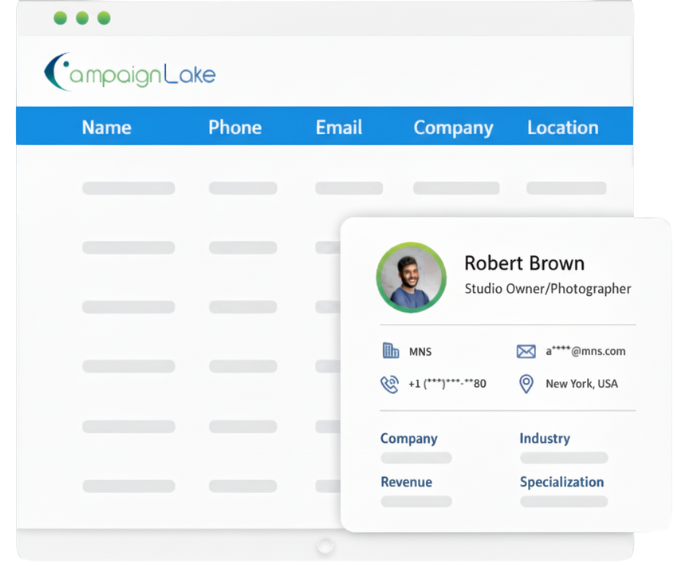
Make Your Marketing Goal as specific as possible and get in touch with CampaignLake at reach@campaignlake.com or call +1 888-840-3334 to avail our highly responsive Retail Business Owners Email List!
Reputable providers use multi-step verification processes to achieve high deliverability rates. Many offer replacement guarantees for contacts that bounce beyond a stated threshold.
Most providers deliver lists in CSV or Excel format, which are compatible with major CRM and email marketing platforms like Salesforce, HubSpot, and Mailchimp.
Yes, quality providers allow filtering by location, retail subsector, company size, revenue, and other firmographic criteria. Segmentation is one of the primary advantages of working with a specialized data provider.
Compliant lists are built from opt-in sources and follow regulations like CAN-SPAM, GDPR, and CCPA. Always verify your provider’s compliance practices before purchasing.
Standard lists are typically delivered within a few business days. Custom lists with specific targeting requirements may take longer depending on complexity.
An email list contains digital email addresses for online outreach, while a mailing list includes physical addresses for direct mail campaigns. Many providers offer combined lists that include both.
If the list includes phone numbers and the contacts have opted in for such communication, it can be used for telemarketing or SMS outreach in compliance with applicable regulations.
Most reputable providers offer replacement credits or refunds for bounced emails that exceed the stated accuracy guarantee. Confirm the specific terms before purchasing.